Canary Deployment
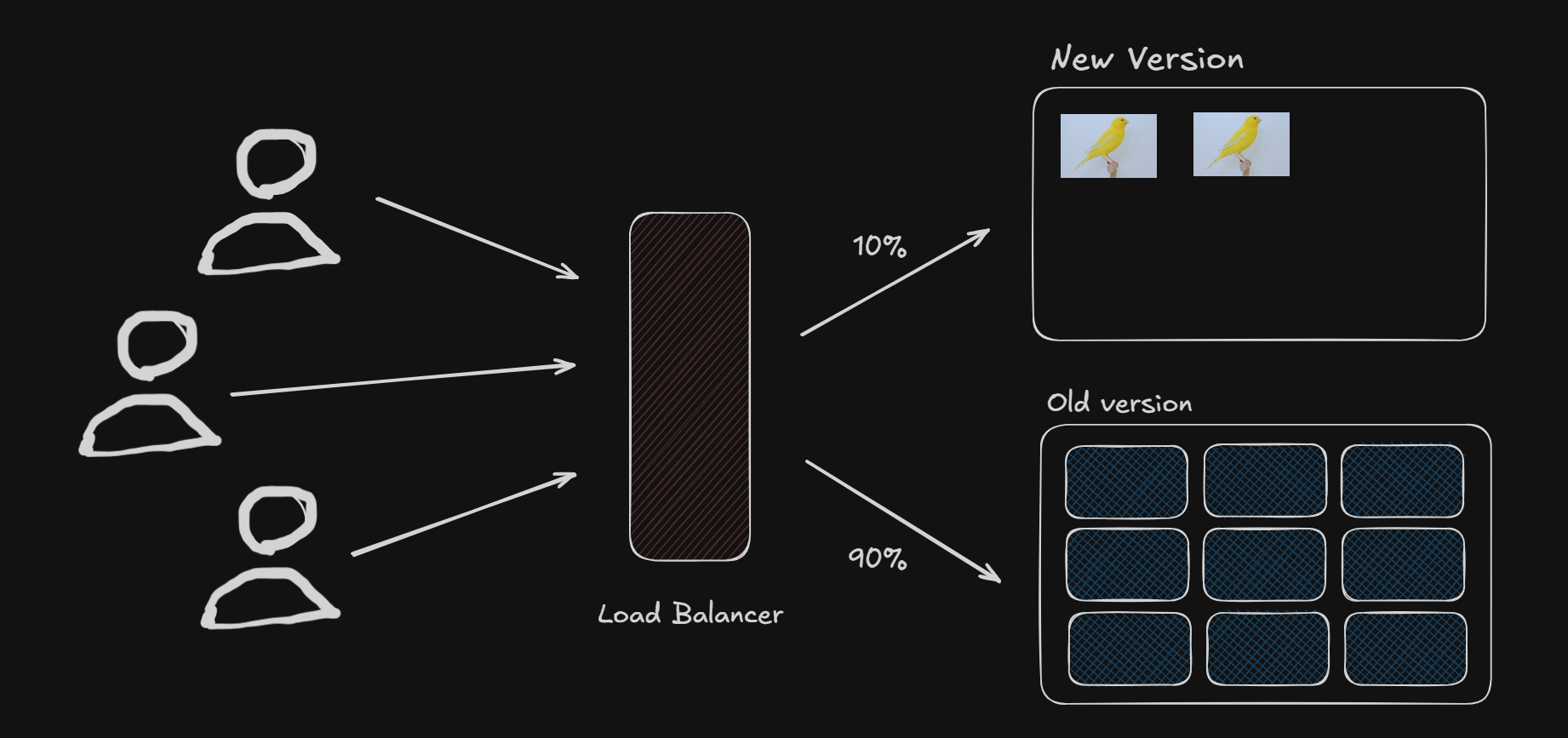
Canary deployment is a release strategy where a new version of a service is introduced to a small subset of users before being rolled out to the entire user base. Instead of exposing everyone to a potentially unstable release, only a limited portion of traffic is directed to the new version at first. This approach reduces the risk associated with deployments and allows teams to validate changes in a real production environment before committing to a full rollout.
How it works
In a canary deployment, both the old and new versions of an application run simultaneously. The stable "old version" continues serving the majority of user requests, while the "new version" receives only a small percentage of incoming traffic. A load balancer or traffic management system is responsible for distributing traffic between the two versions.
Initially, only a small group of users interacts with the new release. During this phase, engineers closely monitor key metrics such as error rates, response times, resource consumption, and application logs. If the new version performs as expected and no significant issues are detected, a larger percentage of traffic is gradually routed to it. This process continues until the new version is serving all users. If any problems arise, traffic can quickly be redirected back to the stable version, minimizing the impact on users.
Why it’s useful
Canary deployments significantly reduce the risk of software releases by limiting the number of users affected by potential issues. They allow teams to observe how new code behaves under real production workloads, which often reveal problems that are difficult to reproduce in testing or staging environments. Because the previous version remains active during the rollout, reverting to a known stable state is straightforward and can usually be done without downtime. This makes canary deployments particularly valuable for organizations that release software frequently and need a safe, reliable deployment process.
Typical rollout flow
A typical canary deployment begins by deploying the new version alongside the existing stable version. Once both versions are running, a small portion of traffic, often around 5% is directed to the new release. The system is then monitored for signs of instability, including increased error rates, higher latency, unusual resource usage, or unexpected behavior in logs.
If the canary version remains stable, the traffic allocation is gradually increased, for example from 5% to 10%, then to 50%, and eventually to 100%. After all traffic has been successfully migrated and confidence in the new release is established, the old version is removed from service.
When to use it
Canary deployment is particularly useful for critical backend services where reliability is essential and deployment failures can have a significant impact. It is also beneficial when real-world user behavior may differ from testing scenarios, making production validation important before a complete rollout. Teams practicing continuous delivery often rely on canary deployments because they provide a controlled and measurable way to introduce changes while maintaining the ability to roll back quickly if necessary.
This strategy is widely used in microservice architectures and large-scale distributed systems, where even small defects can affect thousands of users. By gradually increasing exposure to the new version, canary deployments provide a balance between rapid delivery and operational safety.
Fun fact: The term comes from the practice of coal miners taking canaries into mines. Canaries are very sensitive to toxic gases, so if dangerous gas was present, the bird would show signs of distress before the miners, providing an early warning.
thank you for reading till the end :)